

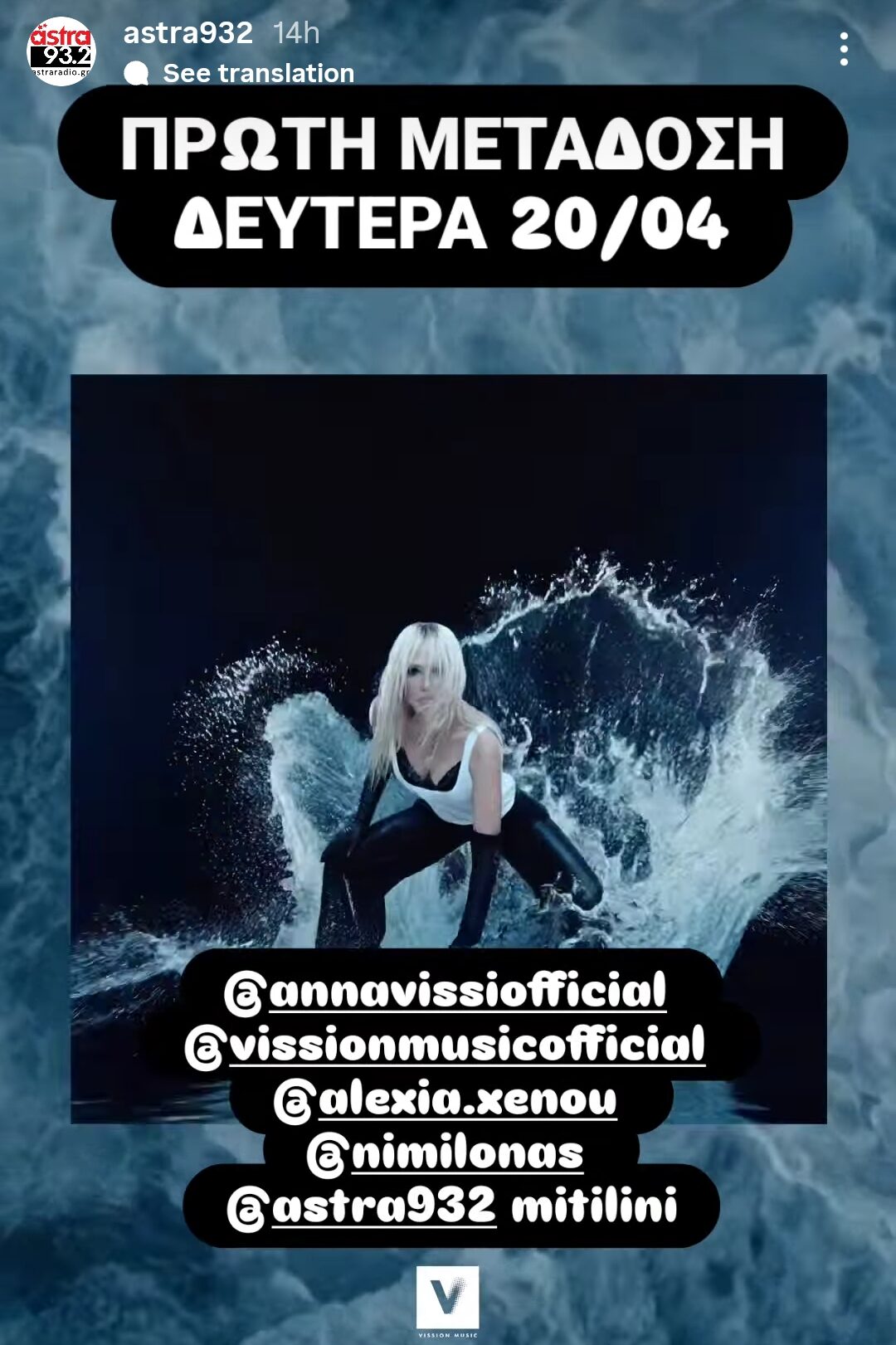
Anna Vissi has left Panik Gold behind her and is ready to launch Vission in full swing with new single “Aigaio”, to be released on digital platforms Friday 24th. With that comes a limited radio run from, tomorrow, Monday the 20th, as seen below, announced by Astra 93,2 through their Instagram stories.
While Vissi’s star power and decades-long career naturally grant her access to such promotional opportunities, her radio run highlights a deeper issue: how fair is this model in a small market like Cyprus, where radio airplay is a critical gateway to success?
Back in 2019, the Rolling Stone magazine reported how labels in the United States paid for songs to be played on radio stations. The radio industry’s pay-for-play system and exclusive agreements are primarily controlled by major labels and independent promoters, creating significant challenges for independent artists. The radio stations frequently require financial incentives or established connections with labels to include songs in their playlists, which many independent artists lack the resources or means to provide.
There is nothing official that the same pay-for-play exists in Cyprus, however, it raises eyebrows when Panik Entertainment Group occupies eight out of the top 10 in the Airplay Chart of 2025 (which combines radio stations from Greece and Cyprus, according to MediaInspector) as reported by TLife, and the most played songs on radio do not translate to the top streaming list of the year in Greece (Giannopoulos & Τσίντζα), nor in Cyprus. This disconnect suggests that radio playlists may not reflect actual listener demand but rather the influence of a few powerful entities.
In a small market like Cyprus, this puts small and independent artists at a tough disadvantage. They lack resources and connections to get played, which in Cyprus, where Cypriot music is not promoted [on radio] like in other countries, like France, even though Cyprus has the most radio stations per capita in the EU, as reported by Cyprus Mail in 2024. That’s why Maria Kouvarou’s radio program at UCY every Wednesday is so important! Playing only Cypriot artists and music.
The public also has a role to play. Imagine saying to a Dane that their end-year list would have no Danish lyrics (DR, 2026) or for French radios to not have any francophone songs in the year-end list (Billboard, 2026); France has a law that states that 40% of all songs played must be in French [=francophone, see full explanation below] (Arcom). In Cyprus, the public could drive change by requesting Cypriot music on radio, playing local artists in tourist areas, and moving beyond the dominance of 80s cover bands. Other nations are seeing and using their culture to hold soft power, like South Korea in recent years with K-pop and K-dramas (Shafie, 2025). Sweden has felt its soft-power music influence waning in the 2020s, and it is taking matters into its own hands, aiming to make Stockholm the “music capital of the world” (Musikindustrin, 2026).
Concluding, in a small market like Cyprus, the dominance of major labels and the lack of structured support for local artists create a challenging environment for musical diversity and fair competition. Vissi’s radio run is a reminder of both the advantages of established status and the systemic barriers that independent artists face. For Cyprus to nurture a thriving, inclusive music scene, the industry and the public must actively champion local talent. By fostering a culture that celebrates and promotes its own artists, on the radio, in public spaces, and through policy, the island can transform its music scene into a vibrant, self-sustaining ecosystem that benefits everyone. The time is ripe for Cyprus to turn its rich musical heritage into a source of pride, influence, and economic opportunity. However, some do not see this point (Philoenews, 2026)
Most streamed songs 2025 in…
– Cyprus [courtesy of us]
– Greece [courtesy of Spotify]
– Türkiye [courtesy of Spotify]
Listen on Wednesdays to “Made in Cyprus” at: https://www.ucyvoice.com/program/wednesday/made-in-cyprus-wed-18-19
Definitions
A French song can mean two things: a song by a French artist or a song IN French, or francophone. A person who speaks French is a francophone. The same applies to Greek (hellenophone), Turkish (turcophone), English (anglophone). When you say [an] English song, do you mean a song in English [anglophone] or do you mean by an English artist (Harry Styles, Dua Lipa, the Beatles)? Could be very different things! Angèle, from Brussels, makes francophone music [music in French] but her music is Belgian. The same applies to Cypriot music. It can be in X language but Cypriot. Language is not nationality, nationality is not ethnicity, ethnicity is not language.